



CAT 320D vs CAT 320D2: Which Used Excavator Should You Buy?
Written and reviewed by KAN, Owner of Anhui Gangya Construction Machinery Sales Co., Ltd.
Experience basis: Regular sourcing, inspection and sales of both CAT 320D and CAT 320D2 units.
Last reviewed: July 2026
1. Quick Answer: CAT 320D or CAT 320D2?
For a used-equipment dealer, choose between the CAT 320D and CAT 320D2 by local resale demand first, then by actual machine condition. A clean 320D may turn over faster and carry less repair risk than an average 320D2. Paying more for a 320D2 makes sense when local buyers value the newer model, the machine will be kept longer, and fuel, parts and repair support can protect the additional investment.
KAN’s dealer rule: A dealer does not earn more simply by buying the newer model. The result depends on purchase margin, repair preparation, resale speed and how long the capital remains tied up. If local buyers already understand and accept the CAT 320D, a clean 320D may create a better annual return than a more expensive CAT 320D2 that takes longer to sell.
Summary Guide
- Lower investment and ordinary rental work:Start with a suitable CAT 320D.
- Longer ownership and proven local demand for D2:Consider a good CAT 320D2.
- Limited repair capability or preference for older mechanical systems:Check an older 3066TA-version 320D.
- Same budget:Buy the stronger engine, hot hydraulics, undercarriage and structure—not the newer decal.
Reading Navigation
- Confirm the exact version
- Check local market demand
- Decide when to choose each model
- Compare two machines at the same budget
- Calculate resale speed and capital exposure
- Check fuel, repair and machine condition
- Review alternatives, FAQs and the final checklist
2. Confirm the Exact 320D or 320D2 Version
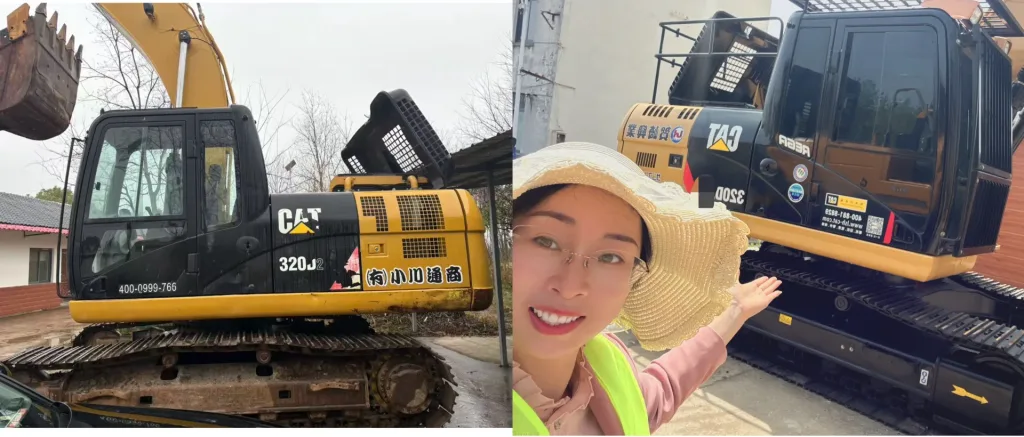
CAT 320D is not one identical configuration worldwide. In the used market, we commonly handle older 320D machines with a 3066TA engine. Later 320D machines may use a C6.4, while C6.6 versions also exist in certain markets.
These versions can differ in engine appearance, cab seat, roof window, filter arrangement, glass markings and other details. The hydraulic pumps may look similar from outside, so visual recognition alone is not enough.
Most CAT 320D2 units we handle use a C7.1 engine.
Market verification note: We have encountered machines offered in the trade as CAT 320D2 with a 6.4-litre engine configuration. Because this is not a configuration we generalize globally, buyers should verify the machine plate, engine plate, serial-number prefix, original market and engine-replacement history.
Caterpillar’s archived information confirms 320D configurations with 3066TA, C6.4 and C6.6, while standard 320D2 listings commonly show C7.1. Use the plates and serial numbers of the actual unit, not the seller’s model description alone.
3. Check Local Demand Before You Invest
Our rolling inventory normally includes around ten CAT 320D units and ten CAT 320D2 units, although the number changes as machines are sold and replaced. Both generate regular inquiries and sales; neither is the clear global winner.
In our export inquiries, buyers in parts of Africa are relatively more open to older 320D machines. This cannot be applied to every country because buyer preference, import rules, service support and resale prices vary.
Use this decision matrix as a starting point:
| Buyer situation | Starting recommendation and what to confirm |
| Local buyers accept older machines | Start with CAT 320D. Confirm the engine version and normal resale time. |
| Buyers request D2 or newer years | Start with CAT 320D2. Confirm whether the resale or rental premium can recover the higher investment. |
| General rental and mixed jobs | A good-condition CAT 320D is usually enough. Confirm downtime risk and service support. |
| Longer ownership with higher annual use | Consider a good CAT 320D2. Confirm fuel quality, service support and total investment. |
| Two machines are offered at a similar price | Choose the cleaner machine. Compare hot hydraulics, undercarriage, structure and expected repair cost. |
Four Ways to Verify Local Demand
- Review inquiries from the last 6–12 months.Separate 320D, 320D2 and engine-version requests; likes and views are not purchase demand.
- Compare completed sales and holding time.Check how long each model normally remains in stock.
- Ask mechanics and parts suppliers.Confirm which systems they can repair and which parts they carry.
- Check import and resale restrictions.Emission rules, machine age and financing can change the safer choice.
A machine that needs a long explanation before every sale is usually not the best inventory choice for a dealer.
4. When to Choose CAT 320D or CAT 320D2
Choose CAT 320D When
A suitable 320D is normally enough for general earthmoving, ordinary rental and mixed projects. It is a practical starting point when the buyer wants to control initial investment or local customers already understand the model.
The older 3066TA version deserves attention where mechanics know older fuel systems. Later C6.4 and C6.6 versions have different repair logic and must be judged separately.
For a dealer, a familiar 320D with stable demand may be more useful than a newer machine that sells slowly. A weak engine, tired hydraulics or serious structural repairs still make an old unit a poor purchase.
Choose CAT 320D2 When
A 320D2 can suit longer ownership, higher annual use or a market where customers actively prefer D2 machines. A rental company may recover the premium if the model improves rental acceptance and reduces idle time.
Its engine, hot hydraulics, undercarriage and service history must support the premium. Local technicians, fuel filtration and parts supply must support the machine as well.
I would pay more for a good 320D2. I would not pay more just because the side decal contains an extra number.
5. Same Budget: Cleaner 320D or Average 320D2?
At the same budget, I normally choose the machine with the better core condition.
Suppose the 320D starts cleanly, holds speed under load, stays responsive when hot and has a usable undercarriage. The competing 320D2 needs fuel-system work, has slow hot hydraulics or requires major undercarriage replacement. The 320D is safer unless the buyer’s market strongly rejects it.
Use this order:
- Cold-start engine condition and exhaust smoke;
- Engine response under working load;
- Combined movements after the hydraulic oil is hot;
- Remaining undercarriage life;
- Boom, stick, X-frame and repair history;
- Local demand for the exact version;
- Expected repair cost and holding time.
A dealer may still repair the D2 when local customers will buy it much faster, but the repair budget and extra inventory time must be calculated before payment.
- [[View Used CAT 320D Options]]
- [[View Used CAT 320D2 Options]]
6. Resale Speed, Total Investment and Capital Turnover
Our main customers are dealers, large brokers, sourcing intermediaries, rental businesses and mine owners. Their priorities overlap, but they make money in different ways.
- Dealersneed demand, margin and a reasonable selling period.
- Brokersneed the correct configuration and evidence that can be shown to the final buyer.
- Rental companiesneed utilization, manageable downtime and fast local repair.
- Mine ownersneed dependable performance under load and should pay extra attention to previous heavy work or breaker use.
Before comparing purchase prices, calculate total capital exposure:
Purchase price + repair preparation + inland and ocean transport + duties and taxes + expected holding cost.
A cheaper excavator can become more expensive after repairs and months of unsold inventory. A large D2 premium can also reduce annual return when local buyers do not value it.
For a trading business, profit per machine and realistic annual inventory turns both matter. The model must leave enough margin after preparation, logistics and time.
7. Fuel, Repair and Inspection Evidence
The older 3066TA-version 320D can be easier to support where mechanics already understand its fuel system. For later C6.4/C6.6 machines and different 320D2 configurations, confirm local knowledge of injectors, pumps, electrical diagnosis and parts.
Caterpillar describes the common C7.1 320D2 as using a mechanically controlled, low-pressure fuel system intended to offer better tolerance in lower-quality-fuel regions. This does not make contaminated diesel or water in the fuel safe. Filtration and maintenance still matter.
The four checks most likely to change the D-versus-D2 decision are cold engine and fuel-system condition, hot hydraulic response, remaining undercarriage cost, and structural or breaker history. On older machines, give more attention to chains, rollers, boom, stick and X-frame. Breaker use can leave cracks, welding or repaired areas hidden by polished photos.
Request four groups of evidence from the same unit:
- Cold start, exhaust smoke and engine sound;
- Combined movements after the machine is hot;
- Travel, swing, undercarriage and structural close-ups;
- Machine plate, engine plate, serial number and full walk-around.
Do not accept an engine video from one machine and an undercarriage video from another. Every important piece of evidence must connect to the unit being offered.
8. Avoid, Alternatives and Final Decision
Avoid a CAT 320D when your country or project has a strict emission requirement, local buyers clearly reject older machines, or the available unit has serious engine, hydraulic, undercarriage or structural wear.
Do not pay extra for a CAT 320D2 when the work is general rental or mixed earthmoving, buyer demand does not reward the newer model, or the actual D2 is weaker than an available 320D.
If neither model fits, consider a CAT 320GC for general earthmoving and buyers who prefer a newer-generation machine. If the customer needs a larger undercarriage, greater stability or a bigger bucket, compare the CAT 323D or 323D2. Those are separate application decisions and should not be reduced to D versus D2.
Final Checklist
- Exact engine and machine version;
- Machine and engine serial numbers;
- Local emission and import requirements;
- Recent local inquiries and completed sales;
- Expected resale or rental period;
- Fuel, parts and repair support;
- Cold engine and hot hydraulic condition;
- Undercarriage, structure and previous work history.
Frequently Asked Questions
Is a CAT 320D2 always better than a CAT 320D?
No. A cleaner 320D can be the safer purchase when its engine, hot hydraulics, undercarriage and structure are better than the available 320D2.
Which model is better for a used-equipment dealer?
Choose the model with verified local demand, an acceptable selling period and enough margin after repairs, logistics and holding cost.
Is CAT 320D suitable for rental work?
Yes. A good 320D is normally enough for general rental and mixed jobs when local emission, fuel and repair conditions allow it.
How should I confirm the engine version?
Check the machine plate, engine plate, serial-number prefix and original market. Do not rely only on the exterior decal or seller’s description.
Compare CAT 320D and CAT 320D2 Options
Tell us your country, buyer type, target resale market, expected work, budget range and preferred engine version. We can compare available CAT 320D and CAT 320D2 units by actual condition and provide connected photos and videos from the same machine before you decide.
- [[CAT 320 vs CAT 323: Which Size Fits Your Work?]]
- [[Why Working Hours Are Not Enough When Buying a Used Excavator]]
- [[Used Excavator Inspection Guide]]