



CAT 320 vs CAT 323: Which Used Caterpillar Excavator Fits Your Job?
Many buyers compare CAT 320 vs CAT 323 when they want a used Caterpillar excavator but are not sure which machine fits their work better.
The CAT 320 is usually the safer and more common choice for general earthmoving, road work, farm work, municipal work, rental, resale and budget control. The CAT 323 makes more sense when the buyer needs more stability, larger bucket capacity, better loading ability or a heavier working feel than a CAT 320 can provide.
But CAT 323 is not automatically better than CAT 320. For used excavators, the model name is only one part of the decision. A clean CAT 320 with clear videos and good condition can be a safer purchase than a tired CAT 323.
Quick Answer: CAT 320 or CAT 323?
Choose CAT 320 if you need a common used excavator for general earthmoving, rental, resale, road work, farm work or budget control.
Choose CAT 323 if CAT 320 feels too light, bucket capacity is not enough, loading is slow, or your jobsite needs more stability.
In used machines, condition comes before model name. A clean CAT 320 can be safer than a tired CAT 323.
If your work is long-term quarry, mining, heavy loading, continuous breaking or high-intensity production, do not force CAT 320 or CAT 323 to do the job. CAT 325, CAT 330 or CAT 336 may be a better direction.
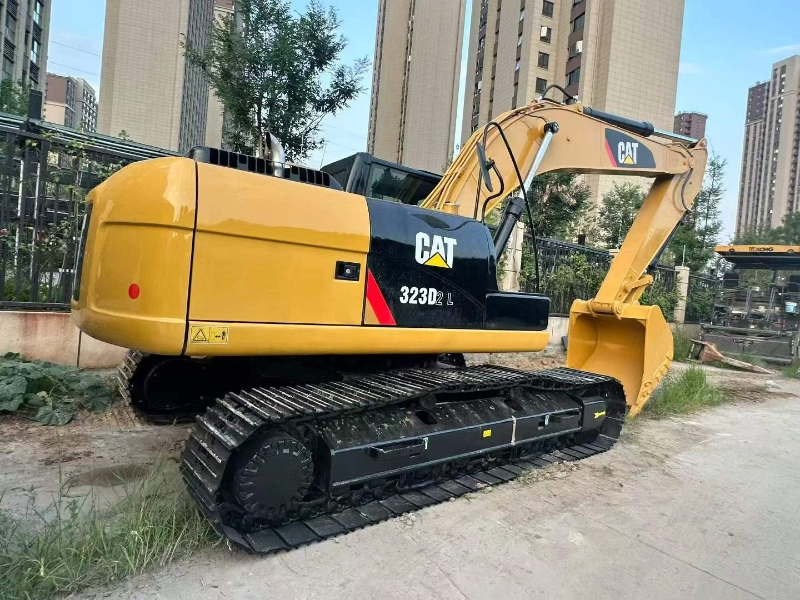
Page Navigation
Use this guide to compare CAT 320 and CAT 323 by work type, resale, budget, generation and used-machine condition.
- Quick answer: CAT 320 or CAT 323?
- Why buyers compare CAT 320 and CAT 323
- Main difference between CAT 320 and CAT 323
- CAT 320 vs CAT 323 decision table
- Used CAT 320 vs CAT 323: condition comes before model name
- Who should choose CAT 320?
- Who should choose CAT 323?
- Who should avoid CAT 320?
- Who should avoid CAT 323?
- When to consider CAT 325, CAT 330 or CAT 336
- Price difference between used CAT 320 and CAT 323
- What videos should buyers request?
- Final decision checklist
- FAQ
- Related buying guides
Why Buyers Compare CAT 320 and CAT 323
Buyers compare Caterpillar 320 vs 323 because both machines are close to the popular medium excavator range.
CAT 320 is widely accepted in many export markets. Dealers, rental companies and contractors already understand this size. It is easier to explain to end users and often easier to resell.
CAT 323 attracts buyers who want something stronger than a standard 20-ton class machine. Some buyers feel CAT 320 is not stable enough for their jobsite, or the bucket capacity is not enough for their loading work. That is when CAT 323 becomes worth considering.
But the comparison must be fair. Buyers should compare the same generation when possible:
| Fair Comparison | Better Buying Logic |
| CAT 320D vs CAT 323D | Compare same D-generation working logic and condition |
| CAT 320D2 vs CAT 323D2 / CAT 323D2L | Good comparison for many export buyers; confirm exact market name and undercarriage version |
| CAT 320GC vs CAT 323GC | Compare cost-control models for normal work |
| Next Generation CAT 320 vs Next Generation CAT 323 | Compare newer generation machines fairly |
Older CAT 320 machines also include 320B and 320C, while CAT 323 does not have the same B or C generation history. Do not compare an old CAT 320C directly with a much newer CAT 323 and then say the 323 is simply better.
In many export deals, buyers should usually compare 320D2 with 323D2 or 323D2L, 320GC with 323GC, or Next Generation 320 with Next Generation 323. Generation and condition can change the real value more than the model number.
One detail buyers should confirm carefully is the engine system. Some older CAT 320D units may have direct-injection engine versions, while newer CAT 320D units are usually electronic-control versions. CAT 323D is generally treated as an electronic-control machine, not a direct-injection option. Buyers should confirm the exact machine plate, engine information and market version before comparing two used machines.
Main Difference Between CAT 320 and CAT 323
The real difference is not only the number in the model name. It is what kind of work the machine can handle every day without being overused.
CAT 320 is usually the more common and flexible choice. It fits more buyers, more jobsites and more resale situations. It is easier for many small contractors, rental buyers and dealers to accept.
CAT 323 is the upgrade choice when the buyer wants more stability, more bucket work and stronger performance under heavier daily use. It can feel more comfortable when loading, handling slightly heavier material, or working on jobsites that need more stability and can safely support the extra machine weight.
CAT 320 is easier to sell, easier to use broadly and easier to control by budget.
CAT 323 earns its higher cost only when the job can use the extra stability, bucket capacity and loading ability every day.
CAT 320 vs CAT 323 Decision Table
| Decision Point | CAT 320 May Fit Better | CAT 323 May Fit Better |
| Main work | General earthmoving, road work, farm work, municipal work | Heavier earthmoving, loading, larger bucket work |
| Buyer type | Dealer, rental company, small contractor | Contractor needing more stability and capacity |
| Resale | Easier to move in many markets | Good when local buyers understand the 23-ton class |
| Budget | Better cost control | Higher cost accepted for more working ability |
| Rental use | More customers understand this size | Rental customers need heavier work |
| Loading | Normal loading work | CAT 320 feels slow or bucket capacity is not enough |
| Jobsite condition | Normal jobsite conditions | Jobsites that need more stability and can support extra machine weight |
| GC models | Normal work and cost control | Normal heavier work, not long-term mining or breaking |
| Heavy work | Not for long-term quarry or mining | Better than 320, but still not a 330 or 336 replacement |
| Used condition | Clean CAT 320 is available | Clean CAT 323 is available and the project needs it |
This table is a decision filter, not a replacement for inspection. The final choice still depends on the exact machine, generation, videos, hydraulics, undercarriage, engine condition and local resale demand.
Used CAT 320 vs CAT 323: Condition Comes Before Model Name
For used machines, buyers should not compare only the model name. They should compare the actual machine condition.
Before choosing CAT 320 or CAT 323, buyers should check:
- machine generation and market version
- engine system and local repair ability
- undercarriage wear
- hydraulic response
- engine smoke and cold start
- walking, turning and swing movement
- bucket pins and working attachment condition
- machine plate and current machine videos
A larger CAT 323 with unclear videos, weak hydraulics or worn undercarriage can be a worse purchase than a cleaner CAT 320.
A CAT 320 can be easier to accept in many markets because the size is common. But buyers should still confirm the exact generation and engine system. A CAT 320D, CAT 320D2, CAT 320GC and Next Generation CAT 320 should not be judged as the same repair risk.
For the same reason, a CAT 323D, CAT 323D2 / 323D2L, CAT 323GC and Next Generation CAT 323 should also be compared by real condition, not only by the model name.
Who Should Choose CAT 320?
CAT 320 is often the safer business choice for buyers who need a machine that more customers understand, more mechanics can handle and more dealers can resell.
It fits general earthmoving, road work, municipal projects, farm work, small and medium contractor jobs, rental business, dealer resale and budget-controlled buying.
For many dealers and rental buyers, CAT 320 is easier to move because more customers understand this size. It can also be a practical choice when buyers want a common model range and do not want to take extra risk on a heavier machine that their local market may not need.
With the same budget, a buyer may sometimes find a cleaner CAT 320 than a CAT 323. If the CAT 320 has better undercarriage, smoother hydraulics, clearer videos and stronger overall condition, it may be the better used-machine purchase.
Do not underestimate a good CAT 320. For normal work, the right CAT 320 can make more business sense than buying a larger machine the job does not really need.
Who Should Choose CAT 323?
CAT 323 should be considered when CAT 320 is not enough for the job.
A buyer may consider CAT 323 when CAT 320 feels too light, bucket capacity is not enough, loading efficiency is too slow, the jobsite needs more stability, or the buyer handles heavier soil and larger daily volume.
CAT 323 can be a good upgrade for buyers who need more machine but do not want to jump directly to a much larger class.
It is especially useful when the buyer has already used machines around the CAT 320 size and knows the job needs something stronger. In that case, choosing CAT 323 is not just buying a bigger name. It is solving a real jobsite problem.
But if the job is still normal earthmoving, rental or resale, CAT 320 may remain the cleaner choice.
Who Should Avoid CAT 320?
Avoid CAT 320 if the machine will be pushed into work that is too heavy for it every day.
CAT 320 may not be the best choice when the work is heavy loading every day, the bucket feels too small, production is too slow, the jobsite needs more stability than CAT 320 can provide, or the buyer plans to use it like a bigger machine.
If a buyer already knows the job needs more bucket capacity, heavier loading and stronger stability, choosing CAT 320 only to save money may create a bigger cost later. The machine may work, but it may work too hard every day.
In that case, CAT 323, CAT 325, CAT 330 or CAT 336 should be compared honestly.
Who Should Avoid CAT 323?
Avoid CAT 323 if your work is mostly normal earthmoving, rental, resale, farm work, light road work or small contractor jobs, and the extra machine size will not create real income.
CAT 323 may not be the best choice when the buyer wants the lowest practical budget, local customers understand CAT 320 better, resale speed is more important than extra capacity, transport cost pressure is high, or the CAT 323 condition is unclear.
This is very important for used excavators: do not buy a tired CAT 323 only because it is larger. A larger model with weak hydraulics, worn undercarriage or unclear videos can create more trouble than a smaller machine in better condition.
When to Consider CAT 325, CAT 330 or CAT 336
Sometimes the buyer should not stay between CAT 320 and CAT 323.
CAT 325 can be a middle step if the work is heavier than CAT 323 but still not full heavy-production work. For long-term quarry, mining, heavy loading or continuous breaking, CAT 330 or CAT 336 is usually a more honest direction than forcing CAT 320 or CAT 323 to do heavy-class work every day.
CAT 323 is stronger than CAT 320 in many working situations, but it is still not the right answer for every quarry or mining job.
GC models should also be used carefully. CAT 320GC and CAT 323GC can be good choices for cost control and normal work, but they should not be treated as long-term quarry, mining or heavy breaking machines.
Consider CAT 325, CAT 330 or CAT 336 when heavy loading is the daily job, quarry or mining work is long-term, breaking work is frequent, CAT 323 still feels too small, or production demand is high.
Price Difference Between Used CAT 320 and CAT 323
Used CAT 320 and CAT 323 prices should not be judged by model name alone.
Prices change with generation, year, working hours, engine condition, hydraulic condition, undercarriage condition, bucket configuration, paint condition, previous jobsite use, videos, inspection evidence, local demand and current market availability.
In many used-machine comparisons, CAT 323 may cost more than CAT 320 when the generation and condition are similar. But a CAT 323 with poor condition should not be valued only as “a bigger CAT.”
A clean CAT 320 with good videos and better condition may be more valuable for many buyers. The right price is not only the lower number. It is the price that matches the condition, job and resale plan.
Buyers should also compare what is included in the quotation. A machine with clearer videos, better undercarriage, better hydraulic response, cleaner preparation and stronger loading support may have a different value from a cheaper machine with unclear condition.
What Videos Should Buyers Request?
For used CAT 320 and CAT 323 machines, videos are more useful than a simple specification sheet.
Buyers should request current machine videos when possible, including cold start, engine sound and smoke, walking, turning, swing, hydraulic working, boom, arm, bucket movement, undercarriage close-up, bucket pins, machine plate and loading or same-machine confirmation before shipment.
For CAT 320, buyers should pay more attention to whether the machine still has smooth hydraulic response, normal walking power and clean undercarriage condition. Many CAT 320 units are used for rental, road work, general earthmoving and mixed jobsite work for many years. A good CAT 320 should show stable basic movement, not only a clean appearance.
For CAT 323, buyers should pay more attention to stability under load, swing movement, undercarriage wear and whether the larger bucket or heavier working condition has caused extra wear. A CAT 323 should not only look larger. It should prove that the hydraulics, walking system and structure still match the heavier work.
Because used machines are different one by one, the exact video set depends on the current machine and site condition. Buyers should confirm available photos, videos, machine plate and working condition before payment or shipment.
Final Decision Checklist
Use this checklist before choosing CAT 320 or CAT 323.
| Question | If Yes, It Points More Toward |
| Is the job mostly general earthmoving? | CAT 320 |
| Is the buyer a dealer or rental company? | CAT 320 |
| Is resale speed very important? | CAT 320 |
| Is the budget controlled? | CAT 320 |
| Is the buyer looking for a common model range? | CAT 320 |
| Does the buyer need more stability? | CAT 323 |
| Does CAT 320 feel too light for the work? | CAT 323 |
| Is bucket capacity not enough? | CAT 323 |
| Is loading efficiency too slow? | CAT 323 |
| Can the jobsite safely support the heavier machine? | CAT 323 |
| Is the work long-term quarry or mining? | CAT 325 / CAT 330 / CAT 336 |
| Is breaking work continuous? | CAT 330 / CAT 336 |
| Is the CAT 323 condition unclear? | Compare carefully |
| Is there a clean CAT 320 available? | Do not ignore it |
| Are both machines in similar condition? | Choose by job and resale plan |
The question is not only CAT 320 or CAT 323. The question is whether the machine matches the job, the budget and the local resale market.
Compare Available CAT 320 and CAT 323 Machines
You can send your jobsite, budget, target year and destination port. We can help you compare suitable CAT 320 and CAT 323 options based on current machine videos, undercarriage condition, hydraulic response and machine configuration.
For common export choices, you may also compare available CAT 320D2, CAT 320GC, CAT 323D2 / CAT 323D2L and CAT 323GC machines according to your jobsite and budget.
[View Used CAT 320D2 Excavator Options]
[View Used CAT 320GC Excavator Options]
[View Used CAT 323D2 / CAT 323D2L Excavator Options]
[View Used CAT 323GC Excavator Options]
We are an independent used equipment supplier, not an official Caterpillar dealer. Machine availability, year, hours, paint condition and configuration should be confirmed by current photos, videos and machine details.
FAQ
Should I buy CAT 320 or CAT 323?
Choose CAT 320 if you need a common used excavator for general earthmoving, rental, resale, road work, farm work or budget control. Choose CAT 323 if CAT 320 feels too light, bucket capacity is not enough, or the jobsite needs more stability.
Is CAT 323 better than CAT 320?
CAT 323 is not automatically better. It is better only when the buyer can use the extra stability, working weight and bucket capacity. For normal work and resale, CAT 320 may still be the better business choice.
What is the main difference between CAT 320 and CAT 323?
CAT 320 is usually more common, easier to resell and easier to control by budget. CAT 323 is the upgrade choice when the buyer needs more stability, stronger loading ability and a heavier working feel.
Is CAT 320 better for rental and resale?
In many markets, CAT 320 is easier for rental and resale because more customers understand this size. But the final decision still depends on local demand, machine generation, condition, price, videos and repair support.
When should I avoid CAT 320?
Avoid CAT 320 if the machine will do heavy loading every day, use a larger bucket constantly, or if the buyer already knows 20-ton class machines are too light for the project.
When should I avoid CAT 323?
Avoid CAT 323 if your work is mostly normal earthmoving, rental, resale, farm work or light road work, and the extra size will not create real income. A clean CAT 320 may be safer than a tired CAT 323.
When should I choose CAT 325, CAT 330 or CAT 336 instead?
Choose CAT 325, CAT 330 or CAT 336 when the work is beyond normal 20–23 ton class jobs, such as long-term quarry work, mining, continuous breaking, heavy loading or high daily production demand. CAT 323 is stronger than CAT 320, but it should not be used as a replacement for a real heavy-duty machine.
Are CAT 320GC and CAT 323GC suitable for heavy work?
CAT 320GC and CAT 323GC can be good choices for normal work and cost control, but they should not be treated as long-term quarry, mining or heavy breaking machines.
What should I check before buying a used CAT 320 or CAT 323?
Check cold start, engine smoke, hydraulic response, walking, swing, undercarriage, bucket pins, machine plate and current working videos. For used machines, condition should come before model name.
Related Buying Guides
- CAT 320 vs Komatsu PC200: Which Used 20 Ton Excavator Is Better?
- CAT vs Komatsu Used Excavators: Brand, Repair and Resale Comparison
- Why Two Used Excavators with the Same Model Can Have Very Different Prices
- What Videos Should You Request Before Buying a Used Excavator?
- Used Excavator Pre-Purchase Inspection Checklist
- How to Verify the Same Used Excavator Before Shipment