



Many overseas buyers compare Hyundai R210LC-9S and R220LC-9S because both can handle normal 20-ton-class earthmoving. The better choice depends on whether you need lower capital requirement and flexibility or more daily output and larger bucket work.
For a used excavator, model size is only part of the decision. Current condition, local repair support, resale speed and proof of the real model can matter more than a small specification advantage.
Confirm the real model first. Then choose by jobsite, local resale demand, current condition and capital turnover.
Quick Answer: R210LC-9S or R220LC-9S?
Choose R210LC-9S for general earthmoving, rental and mixed projects when lower capital requirement and better condition within the same budget matter most.
Choose R220LC-9S when higher daily production, larger bucket work or stronger local demand for the 220 class can create additional value.
At the same budget, a cleaner R210LC-9S is often safer when the job does not need the extra output of R220LC-9S.
Dealers should also check which model their local market can repair and resell faster.
Hyundai R210LC-9S vs R220LC-9S Summary Guide: Which Model Fits Your Work?
| Buyer Situation | Recommended Direction |
| General earthmoving, rental or mixed work | R210LC-9S — Lower capital requirement and flexible use |
| Higher output or larger bucket work | R220LC-9S — Extra production can justify the higher investment |
| Clean 210 vs average 220 at the same budget | Cleaner R210LC-9S — Choose condition first unless the work needs the 220 advantage |
| Local demand clearly favors the 220 class | R220LC-9S — Stronger demand may support faster resale |
| Local buyers prefer lower prices or faster-moving 210-class machines | R210LC-9S — Lower inventory pressure may improve capital turnover |
| Model identity is unclear | Do not choose yet — Confirm the plate, engine information, undercarriage and current video |
| Need a newer 22-ton option or substantially higher output | Consider another model — Compare HX220D or reassess the 30-ton class |
Reading Navigation
- Main Differences: Investment, Undercarriage, Bucket Work and Output
- When R210LC-9S Is the Better Choice
- When R220LC-9S Makes More Sense
- Who Should Avoid R210LC-9S or R220LC-9S?
- When Should You Consider Another Hyundai Model?
- Same Budget: Cleaner R210LC-9S or Average R220LC-9S?
- Local Resale, Repair Support and Capital Turnover
- How to Confirm the Real Model Before Comparing Price
- Used-Machine Inspection Points
- Final Decision Checklist
Why Buyers Compare R210LC-9S and R220LC-9S
The two models are close enough that buyers often ask whether the lower-priced 210 can finish the same work or whether the 220 will earn more through output and resale.
In our regular used Hyundai business, R220LC-9S usually has more available options and receives clearly more inquiries than R210LC-9S.
This is a sales and market reference, not a reason for every buyer to choose the larger model.
Actual availability, year, displayed hours and condition should always be confirmed from current units.
The real question is whether the extra investment in R220LC-9S will be recovered through higher production or faster local resale.
Main Differences: Investment, Undercarriage, Bucket Work and Output
Main Working Position
R210LC-9S
A flexible, lower-capital direction for buyers who need one machine to handle different types of normal work.
R220LC-9S
A higher-output direction for buyers who regularly need more production or larger bucket work.
Typical Work
R210LC-9S
More suitable for:
- general earthmoving
- rental
- road work
- drainage
- municipal projects
- mixed jobs
R220LC-9S
More suitable for:
- production-focused earthmoving
- larger bucket loading
- higher daily output
- heavier work than normal earthmoving
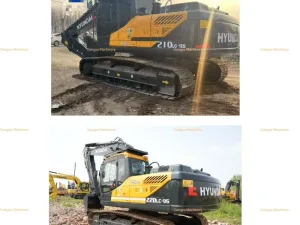
Common Undercarriage Setup
On common machines we handle:
- R210LC-9S usually has 7 bottom rollers per side
- R220LC-9S commonly has 9 bottom rollers per side
The common R220LC-9S setup has a longer support footprint and can provide a more stable working platform in some soft or wet conditions.
Actual performance still depends on:
- track-shoe width
- undercarriage condition
- soil condition
- actual machine configuration
Roller count is a useful screening point, not final proof of model identity.
Bucket Work
R210LC-9S usually uses a smaller general-purpose bucket setup.
R220LC-9S is more often selected when larger bucket work and higher production are important.
Actual bucket size and configuration should still be confirmed from the current machine.
Used-Machine Buying Priority
For both models, condition comes first.
Check:
- engine performance
- hydraulic response
- undercarriage condition
- structure
- leakage
- current working video
For R220LC-9S, inspect the larger undercarriage carefully because replacement cost can be higher.
When R210LC-9S Is the Better Choice
R210LC-9S is often the practical choice for:
- rental work
- road construction
- drainage projects
- municipal work
- normal earthmoving
- mixed projects
It fits buyers who want:
- lower capital requirement
- flexibility across changing jobs
- lower operating pressure
- better condition within a limited budget
When the project does not need the extra output of R220LC-9S, the 210 may reduce purchase and operating pressure without reducing the customer’s real earning ability.
When R220LC-9S Makes More Sense
R220LC-9S makes more sense when:
- the project is paid by earthmoving volume
- higher daily production affects revenue
- larger bucket work is regular
- work intensity is higher
- the local market clearly prefers the 220 class
Its advantage should be used every day, not purchased only for a larger model number.
For dealers, stronger demand can support faster resale.
However, local evidence should be checked instead of assuming that our sales pattern applies to every country.
Who Should Avoid R210LC-9S or R220LC-9S?
Avoid R210LC-9S when:
- The project regularly needs higher output than a general 20-ton machine can deliver efficiently.
- Larger bucket loading directly determines daily income.
- The customer or resale market specifically requires the 220 class.
Avoid R220LC-9S when:
- The work is mainly normal earthmoving, rental or mixed projects.
- The same budget buys a rough 220 but a much cleaner 210.
- Transport, fuel and undercarriage costs are highly sensitive.
- The project cannot use the extra output enough to recover the higher investment.
A larger machine with weak hydraulics, a tired engine or worn undercarriage can be worse than a smaller machine in better condition.
When Should You Consider Another Hyundai Model?
Do not force the decision between these two models when neither fits.
Compare a newer 22-ton option such as Hyundai HX220D when generation and newer configuration matter.
If the work requires continuous heavy production beyond the practical 20-ton range, reassess whether a 30-ton-class machine is more suitable.
If the budget only reaches poor-condition examples:
- reduce the year requirement
- change model direction
- wait for a better unit
- choose a cleaner machine instead
The third choice can be:
- newer
- larger
- lower in year but better in condition
- simply a cleaner machine
Before moving to another model, first identify whether your real problem is:
- output
- machine generation
- local repair support
- used-machine condition
A newer or larger model only makes sense when it solves a real operating or resale problem.
Ask yourself:
- Will a 20-ton machine work near full load every day?
- Will a newer generation or larger machine reduce enough downtime or increase enough output to justify the higher total cost?
Same Budget: Cleaner R210LC-9S or Average R220LC-9S?
If R210LC-9S can handle the job, we usually prefer a cleaner 210 over an average 220 at the same budget.
A cleaner R210LC-9S may offer:
- better undercarriage condition
- cleaner hydraulic performance
- less visible leakage
- better overall machine condition
- lower repair risk after arrival
Choose R220LC-9S when its extra output, stability or resale demand is genuinely needed.
Otherwise, choose the better machine, not the larger badge.
Local Resale, Repair Support and Capital Turnover
Dealers and brokers should check:
- local machine population
- mechanic familiarity
- parts supply
- customer acceptance
- resale speed
We have not found one reliable regional rule that applies to every country.
For many dealers, faster capital turnover matters more than a small specification advantage.
A model that local buyers understand and local mechanics can support may create more profit than a larger machine that sells slowly.
Before choosing for resale, ask:
- Which model sells faster in your local market?
- Which model do local mechanics understand better?
- Are parts and undercarriage components easier to source for one model?
- Do local buyers pay more for the 220 class, or do they mainly compare purchase price?
How to Confirm the Real Model Before Comparing Price
In some used-equipment listings, nearby commercial names such as 215, 220 or 225 may appear together.
Listing names and decals are not proof.
Check:
- machine plate
- serial information
- engine information
- undercarriage configuration
- current photos
- current working video from the same machine
Also:
- Compare current photos with unique appearance and undercarriage details.
- Keep the quotation, photos, videos and chat records together.
- Use roller count only as a visual screening point.
On common machines we handle:
- R210LC-9S usually has 7 bottom rollers per side.
- R220LC-9S commonly has 9 bottom rollers per side.
However, roller count should not replace machine identification.
A replacement engine is not automatically a problem.
The risk is poor matching between:
- engine
- wiring
- sensors
- control system
- hydraulic system
Judge the current machine by operation, temperature, electrical condition and hydraulic response, not only by the engine label.
Used-Machine Inspection Points
Before payment, request current evidence from the actual machine.
Check:
- cold start
- engine sound
- smoke
- idle stability
- boom movement
- arm movement
- bucket movement
- combined hydraulic movement
- walking
- straight travel
- swing
- hot-machine operation
- visible oil leakage
- boom and arm structure
- pins
- machine plate
- engine information
- dashboard condition
- current undercarriage photos
- undercarriage close-up video
For R220LC-9S, pay extra attention to:
- bottom rollers
- track chain
- track shoes
- idler
- sprocket
- track frame
- final-drive sound
- straight travel
The larger undercarriage can create higher replacement cost.
If the seller cannot provide current hot-machine working video, do not compare price first. Without current evidence, the buyer is only comparing descriptions.
Final Decision Checklist
| Your Situation | Decision |
| General earthmoving, rental or mixed projects | Start with R210LC-9S |
| Higher output or larger bucket work creates income | Choose R220LC-9S |
| Clean 210 vs average 220 at the same budget | Choose the cleaner 210 unless the work needs the 220 advantage |
| Local demand is uncertain | Check mechanics, parts supply and resale speed |
| Model identity is unclear | Confirm plate, engine information, undercarriage and current video first |
| Neither model fits | Compare a newer 22-ton option or reassess the 30-ton class |
Do not buy only because the model is larger.
Do not buy only because the price is lower.
Choose the machine that gives the best balance of:
- jobsite output
- current condition
- repair risk
- resale speed
- capital turnover
Ask for Hyundai 20 Ton Excavator Options
Send us:
- destination country
- preferred model
- budget
- job type
- daily production target
- local resale preference
We can compare current R210LC-9S and R220LC-9S options by:
- year
- displayed hours
- engine
- paint condition
- undercarriage
- hydraulic response
- current working video
Current availability changes. Final model, year, displayed hours, engine, undercarriage, price and condition should be confirmed from the current unit.
[Ask for Hyundai 20 Ton Excavator Options]
Related Buying Guides
- How to Choose the Right Used Excavator Size for Your Job
- Used Excavator Pre-Purchase Inspection Checklist
- What Videos Should You Request Before Buying a Used Excavator?
- Why Two Used Excavators with the Same Model Can Have Different Prices
FAQ
What is the difference between Hyundai R210LC-9S and R220LC-9S?
R210LC-9S is usually the lower-capital and more flexible choice for general earthmoving, rental and mixed projects.
R220LC-9S is usually selected when higher daily output, larger bucket work or stronger 220-class demand matters.
Is R220LC-9S always better than R210LC-9S?
No.
R220LC-9S is more valuable when the project can use its additional output or local resale demand is stronger.
For normal work, a cleaner R210LC-9S can be the safer purchase.
Should I buy a cleaner R210LC-9S or an average R220LC-9S?
If the job does not need the extra output of R220LC-9S, we usually prefer the cleaner R210LC-9S.
Better undercarriage, hydraulics and overall condition can reduce repair risk.
Which model is better for a dealer buying for resale?
Choose by local demand, repair support and resale speed.
R220LC-9S can be the better direction where buyers clearly prefer the 220 class and are willing to pay more for it.
R210LC-9S may be safer where lower purchase price, faster turnover and broader affordability matter more.
How can I confirm the real model before buying?
Do not rely only on decals or listing names.
Check the machine plate, serial information, engine information, undercarriage configuration, current photos and current working video from the same machine.
When should I consider another Hyundai model?
Compare HX220D when you want a newer 22-ton direction.
If the work requires continuous heavy production beyond the practical 20-ton range, reassess whether a 30-ton-class machine is more suitable.